An uncomfortable truth for ALL low and middle income earners....
For Most Workers, Real Wages Have Barely Budged For Decades And This Pay Squeeze Continues With No End In Sight.
A Special Report by Brendan Casey [download in pdf format]
You may have noticed your income isn't keeping step with the cost of living anymore. Maybe you think twice before taking the whole family out for a meal. Or you find yourself doing the math before deciding to buy your kids ice cream or cake. Perhaps it's a few years since you and your partner have had a decent vacation? Or you're keeping your cars longer than you used to. If so, you're not alone.
You may even be feeling some cost of living pressures. You dread opening your utility bills when they arrive. Even though you've kept the heating turned down as low as you can to avoid 'bill shock'. If this is the case, you're not alone here either.
And the reason is this: in most developed countries, wage growth in real terms (above inflation) has been in decline for decades.
In America, real wages for low and middle income employees have been in decline for a very long time. This is a multi-decade trend, the start of which predates the global financial crisis (GFC) and the Great Recession that followed. Chart 1 below shows wage growth for production and non-supervisory workers in the U.S. between 2007 and 20151. As you can see, the trend is down. According to the Bureau of Labor Statistics (BLS), production and non-supervisory employees account for 83% of workers employed in the private sector.

Chart 1.
The BLS's definition of production employees includes working supervisors and all nonsupervisory employees engaged in fabricating, processing, assembling, inspecting, receiving, storing, handling, packing, warehousing, shipping, trucking, hauling, maintenance, repair, janitorial, guard services, product development, auxiliary production, recordkeeping, and other services closely associated with the above production operations.
Non-supervisory employees include those individuals in private, service-providing industries who are not above the working-supervisor level. This group includes office and clerical workers, repairers, salespersons, operators, drivers, physicians, lawyers, accountants, nurses, social workers, research aides, teachers, drafters, photographers, beauticians, musicians, restaurant workers, custodial workers, attendants, line installers and repairers, laborers, janitors, guards, and other employees at similar occupational levels.
So the trend in Chart 1 represents the average of a lot of different occupations with varying pay rates. Chart 2 below shows the real change in hourly wages between 1979 and 2013 for low, middle and high wage workers in the U.S2.
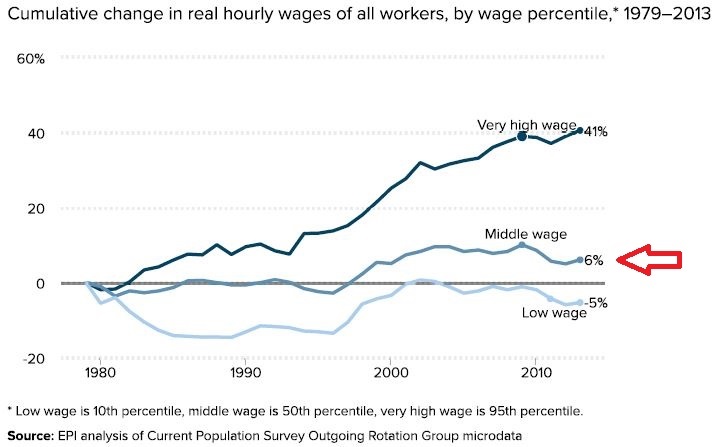
Chart 2.
As you can see from Chart 2, the pay of middle wage workers in the U.S. has only increased 6% since 1979, and has been more or less flat since 2000. While low wage workers have gone backwards over the same period.
And this wage decline problem is not confined to the U.S. According to the UK Office of National Statistics (ONS), workers in the UK were earning £15 less every week in July 2017 than they were in March 20083. Chart 3 below shows real wage growth in the UK between 2001 and 20134. The long-term trend is also down.

Chart 3.
It's a similar story in Australia too. Chart 4 below shows annual growth in real wages for private sector and public (government) employees between 2005 and 20155. Once again the trend is down, but government workers are doing slightly better than those in the private sector.

Chart 4.
So real wage decline is a long entrenched problem that's affecting the living standard of all but the highest paid workers in many developed countries, not just in the U.S. But what is causing it? Professional economists offer a variety of theories on the contributing causes. They include:
- Slack in the labor market.
- Erosion of collective bargaining.
- Rising employee benefit costs.
- Global integration and trade with low wage countries.
- Rapid advancement and adoption of new technologies.
- Lagging educational attainment.
Of the six contributing factors listed above, only the last one, educational attainment, is something that an individual like you and I can do anything about. The other five are way outside of our control.
And as you now know, if you sit around waiting for your income to improve on its own, the long-term nature of this downtrend suggests you'll be waiting for a very long time. This means unless you're totally satisfied with your current level of income, which is almost certainly declining in real terms, doing nothing is not an option.
So what IS the best course of action?
Two things:
1. In the absence of regular pay rises that exceed the never-ending increase in cost of living, the only practical option is to improve your pay grade.

Chart 5. Moving up to a higher pay grade.
How do you do that? Increase the level of knowledge and expertise you bring to the marketplace. Sounds simple enough. But to get maximum leverage from this effort, it must be done in a strategic way. Which means you must...
2. Apply the law of scarcity in selecting the type of knowledge and expertise you will acquire. In other words, choose an industry where there is scarcity of that expertise and therefore high demand for it.
High demand and low supply not only increases the available opportunities, making it easier to move to a higher pay grade, it also drives up real pay. And this is the exact, one-two double punch we're looking for.
The Law of Scarcity
Let me give you an example of the scarcity law in action. Eddie Harmon is proprietor of NC Servo, a business that specializes in the sale and repair of servo and proportional valves. He brought this interesting factoid to my attention recently:
"In SE Michigan there are 25,000 electronics jobs and only 2,500 hydraulics jobs. Sounds good for the electronics techs doesn't it? However there are 50,000 techs looking for the 25,000 electronics jobs and only 500 techs looking for the 2,500 hydraulics jobs."
Based on my own observations and my discussions with others who pay attention to this sort of thing, the supply/demand situation described by Mr Harmon for the hydraulics jobs rings true. And I'm not alone in this observation. According to the 2017 Salary & Career Report published by Hydraulics & Pneumatics magazine5, which surveyed over 1,000 fluid power engineers, 91.5% of respondents agreed that there is a scarcity of appropriately skilled fluid power support staff: technicians, repairers, installers and maintenance personnel.
As for the apparent, gross oversupply of electronics techs described above, it's at least consistent with the opportunity for much earlier exposure to that discipline--in high school or even earlier for some, and the fact that electronics/computer science/ IT, collectively: "Tech" pretty much rules the world these days. This makes electronics appear to be a far more attractive choice in terms of prestige and opportunity than hydraulics. But clearly this is not the case, as the above example illustrates.
Compete for, or choose from?
Would you prefer to be one of the 50,000 competing for 25,000 jobs, or one of the 500 choosing from 2,500 jobs? It's a no-brainer. Not only are there 5 job openings for every skilled hydraulics candidate, the competition from employers drives up the prices (salaries) they're willing to pay.
So scarcity provides more opportunities, forces up pay and lowers resistance to moving up to a higher pay grade. And this is precisely where you want to position yourself in this era of declining real wages. An era that's not going away anytime soon.
While hydraulics is not the only option that fits this strategy for escaping real wage decline and the decline in living standard that follows, the fact you're reading this means you likely already have some affinity for it. Perhaps you work on or around hydraulic equipment, even if only occasionally, but haven't thought of or bothered to study it seriously. Well, in the absence of a better plan, you should.
Don't worry, you don't have to complete a College course. Or even attend vocational training. Although that is one option. But you will need to invest some of your hard-earned AND some of your personal time in order to position yourself to play in this space and get the results we've been talking about here.
How much hard-earned and how much personal time? Well, if you're prepared to invest a couple hundred dollars, $279 to be exact, and spend an hour every week for a year studying, you will be in a positon to enter this niche. And for reasons already explained, once you're in, you'll have maximum opportunity to ascend through the ranks--and pay grades. Recall that this is the whole point of this strategy in the first place: moving up to a higher pay grade.
No 'ticket'? No problem
Now you might be thinking you need a piece of paper for this. The short answer is you don't. Certificates and diplomas are always a good thing to have for any specialization. But due to the fact that formal, school training in hydraulics tends to be superficial and patchy, most professionals in the hydraulics biz get the bulk of their expertise through self-learning. On and off the job. In other words, they're self-taught.
And according to the 2017 Salary & Career Report published by Hydraulics & Pneumatics magazine5, which surveyed over 1,000 fluid power engineers, 28% said their firms hired fluid power support staff: technicians, repairers, installers and maintenance personnel from sources other than technical trade and vocational schools. So while a piece of paper is always advantageous to gaining entry, this proves it's not mandatory in the hydraulics profession.
In terms of the investment, a couple hundred bucks may be a little or a lot depending on your situation. Either way, it's possible you spent more than this on your smart phone. And unless you're an Uber driver in your spare time, that spend is doing nothing for you to improve your income. Think about that for a moment.
As for the personal time, I don't know anyone who can't find just one hour a week. Get up an hour earlier on Sunday morning if you have to. It's not that hard. If you think you're too busy to pursue this strategy, frankly, you're kidding yourself. Oh, and if you'd prefer to accelerate the process, spend an hour a day for just 8 weeks and you're on your way.
What to do next...
"On your way" is a good way to describe it. Because if you do decide to do this, you are embarking on a journey. And if you've done any travelling abroad, you've likely used a Frommers or Lonely Planet guide. If so, you would have studied it before you left, hi-liter and sticky notes in hand. And while on your journey you would have kept it close and referred to it over and over.

The combination of reading about the place beforehand and then being immersed in the place made it all make sense. This is precisely why these travel guides are so popular. And this is exactly what I'm suggesting you invest in today: a set of books that will guide your journey into hydraulics land and ensure it is safe and successful.
But remember this is not a jolly. It's a tactical foray into a place that offers a different kind of escape. Escape from real wage decline and the decline in living standard that results. If you're on board for this, and you should be, there are two routes you can take:
Industrial Hydraulics Specialist
Mobile Hydraulics Specialist
And as you can guess, the choice is easy. If your work experience is mainly in the industrial domain, then Industrial Hydraulics Specialist is the obvious path to take. If your work experience is tilted more towards mobile machines, then Mobile Hydraulics Specialist is the natural choice.
Remember, this is a strategic acquisition of knowledge for a specific end: putting yourself in a place where competition for suitable candidates drives wage growth and makes it easier to move to a higher pay grade, faster. And as with any journey the sooner you start, the sooner you finish. So don't delay, get your ticket today:
Industrial Hydraulics Specialist
Mobile Hydraulics Specialist
As the charts included in this report show, if you do nothing and wait for a return to above inflation wage increases to improve your real income and living standard, you could get old waiting. And die working. But as you now know, there is no need to be held hostage to this situation. You have a strategy. You can do something about it. So act boldly and begin today.
Oh, and if you already own one or more of the guides included in the Industrial Hydraulics Specialist or Mobile Hydraulics Specialist packages, you can get the others here.
Powered by:

© HydraulicSupermarket.com
Questions? Email us at info@HydraulicSupermarket.com.
References
- http://www.zerohedge.com/news/2015-04-03/great-news-wage-growth-america-has-never-been-higher-your-boss
- http://www.epi.org/publication/charting-wage-stagnation/
- https://www.theguardian.com/business/2017/jul/12/uk-pay-squeeze
- https://www.adamsmith.org/blog/economics/maybe-keynes-was-right-after-all
- http://www.hydraulicspneumatics.com/community/2017-hydraulics-pneumatics-annual-salary-career-report-pdf-download